
This debate comes up in almost every client conversation we have.
Someone’s read a blog post saying guest posts are dead. Someone else swears by niche edits. And there’s always that one LinkedIn post claiming one is a Google penalty waiting to happen and the other is the holy grail of link building.
The truth? Neither camp is fully right. And the real answer isn’t as clean as most guides make it out to be.
We’ve run both strategies across dozens of campaigns SaaS companies, e-commerce stores, local service businesses, affiliate sites. We’ve watched guest posts outperform niche edits on the same domain. We’ve also seen niche edits move rankings in three weeks when guest posts on the same site did almost nothing for months.
So let’s talk about what actually matters. Not theory. Not what the textbooks say. What we’ve actually seen work in 2026.
First, Let’s Make Sure We’re Talking About the Same Thing
What is a Guest Post?
A guest post is a brand new article you (or your agency) writes and gets published on someone else’s website. Inside that article, there’s a contextual link back to your site.
You pitch a topic. The site editor approves it. Content gets written. It goes through their editorial process. And eventually after revisions, back-and-forth emails, and sometimes a wait of a few weeks your article goes live with your backlink in it.
The key thing to understand: the page is brand new. It has zero existing authority, zero traffic history, and zero indexed backlinks of its own on day one.
What is a Niche Edit?
A niche edit sometimes called a link insertion is when your link gets added into an article that already exists and is already live on the web.
Think of it like this: a site has a post called “10 Best SEO Tools for 2024” that’s been live for two years, gets 3,000 monthly visitors, and has 40 backlinks pointing to it. You reach out, negotiate, and they add your tool into that article with a contextual link. Your link is now sitting inside a page with existing authority, existing traffic, and existing trust signals.
No new content needed. No waiting for a new page to get indexed. Your link plugs straight into a page that Google already knows and trusts.
One is building a new house from scratch. The other is moving into an established neighborhood where everyone already knows the address.
The Real Differences Nobody Talks About Honestly
Speed of Impact
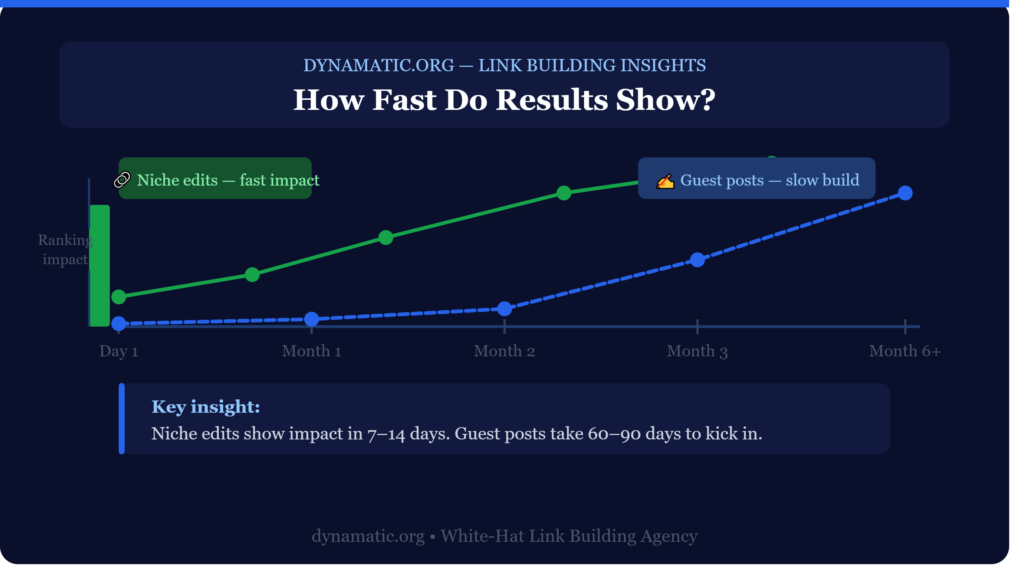
This is where niche edits have a genuine, meaningful advantage and it’s not even close.
When a guest post goes live, Google has to find the page, crawl it, index it, and then evaluate it. That process alone can take anywhere from a few days to several weeks depending on the site’s crawl frequency. Then the link equity has to start flowing. Then your target page has to respond to that new authority signal.
We typically tell clients to expect 60–90 days before a guest post link starts showing any meaningful impact on rankings.
Niche edits are different. The page is already indexed. Google’s already crawling it regularly. When your link gets inserted, it’s usually picked up within days. The authority transfer is faster because the page already has established equity to pass along.
If you’re running a time-sensitive campaign a product launch, a seasonal push, a competitive sprint niche edits are almost always the better short-term play.
Control Over Context
Guest posts win here. No question.
When you write the article, you control everything the topic, the surrounding content, the anchor text, where in the article the link appears, and how naturally it’s integrated. You can build an entire piece of content specifically designed to support the page you’re linking to.
With niche edits, you’re inserting your link into content that already exists and wasn’t written with your site in mind. Sometimes the surrounding context is perfect. Sometimes it’s awkward. Sometimes the article is decent but a bit outdated. You don’t always get to choose the paragraph your link lives in.
That said a well-placed niche edit in a genuinely relevant article is still extremely powerful. Context matters, but so does the authority of the page itself.
Cost
Generally speaking, niche edits are cheaper than guest posts. The reason is simple: there’s no content creation involved. You’re not paying for a writer, for editorial time, or for the hours it takes to go back and forth with a site editor over revisions.
Guest posts carry more overhead which is why they typically cost more, especially on high-authority publications with strict editorial standards.
That said, be careful about judging links purely by price. A $400 niche edit on a DR 65 site with 15,000 monthly visitors is worth far more than a $150 guest post on a DR 30 site with 200 monthly visitors. Price is a rough signal, not the full picture.
Check out our link building packages to see how we price both strategies transparently no hidden fees, no inflated anchor text charges.
Brand Building and Referral Traffic
Guest posts genuinely build your brand in a way niche edits don’t.
When you publish a well-written article on an authoritative site in your industry, real people read it. Some of them click your link. Some of them remember your brand name. Some of them come back later and convert. That’s a layer of value beyond pure SEO.
Niche edits are almost purely an SEO play. The referral traffic from them is usually minimal someone reading an existing article might click your link, but the volume is rarely significant.
If your goal is purely rankings and domain authority, niche edits are efficient. If you also care about brand positioning and getting in front of new audiences, guest posts serve double duty.
Risk Profile
Here’s something a lot of agencies won’t tell you honestly: both carry risk if done poorly.
Bad guest posts published on link farm sites that exist purely to sell placements, with thin content and zero real readership — are increasingly getting caught by Google’s Spam Brain system. A guest post on a site with no real traffic, no editorial standards, and 40 other sponsored posts on the same page is not a safe link. It’s a liability.
Bad niche edits carry their own risk. If the existing page is surrounded by other paid links, if the article is low-quality, or if the insertion looks unnatural and forced that’s a problem too.
The risk isn’t in the strategy. The risk is in the quality of execution. A high-quality guest post on a genuine editorial publication is one of the safest, most powerful links you can build. A high-quality niche edit on a well-trafficked, relevant page is equally strong.
Stop asking which strategy is safer. Start asking whether the site you’re placing a link on is genuinely good. That’s the only question that actually matters.
When to Use Guest Posts vs Niche Edits — A Practical Guide
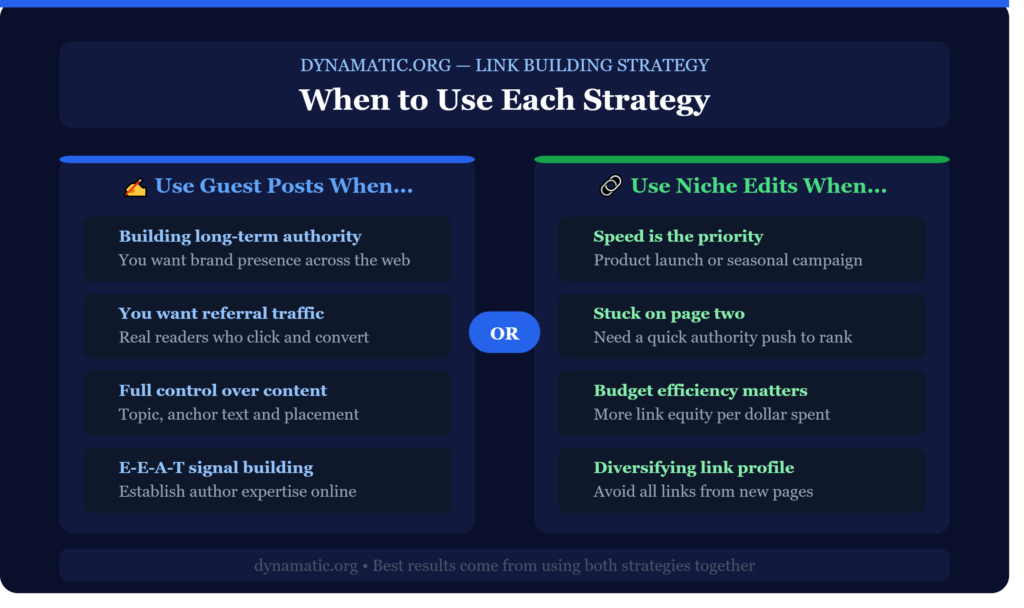
Use Guest Posts When…
- You’re building long-term domain authority and want to establish your brand in a new niche or vertical
- You want referral traffic alongside the SEO benefit real readers who might become clients or customers
- You need to target a very specific topic and want full control over the surrounding content and anchor text
- You’re doing E-E-A-T building Google wants to see your brand and authors associated with authoritative content across the web
- You have time. Guest posts take longer to produce, place, and show impact so they’re a poor choice for urgent ranking campaigns
Use Niche Edits When…
- You need faster results a product launch, a seasonal campaign, or a keyword that’s stuck on page two and needs a push
- You’ve found a highly relevant existing article that already ranks well and gets real traffic inserting your link into that page is extremely efficient
- Your budget is tighter and you want to maximize link equity per dollar spent
- You’re targeting pages that are already performing but need a boost in authority to overtake a competitor
- You want to diversify your backlink profile and avoid having all your links from new guest post pages
Use Both When…
Honestly? The best campaigns we run at Dynamatic use a mix of both. Not because it’s a cop-out answer but because different pages on your site have different needs.
Your homepage and main service pages often benefit from the authority boost of niche edits on aged, high-traffic content. Your blog posts and thought leadership content benefit from guest posts that drive topical relevance and referral traffic.
We map out which strategy suits which target page during onboarding it’s one of the first things we cover. You can see how that process works on our How We Work page.
What Google Actually Thinks About Both Strategies in 2026
Google doesn’t hate guest posts. Google doesn’t hate niche edits. Google hates manipulative, low-quality links regardless of what you call the strategy.
The September 2025 core update put increased scrutiny on backlink quality across the board. Sites relying on bulk guest post networks or cheap link insertion services saw rankings drop. Sites with genuinely earned, editorially placed links — whether guest posts or niche edits — were largely unaffected or saw improvements.
The signal Google is looking for is simple: does this link make sense? Is it on a real site, in relevant content, pointing to something that adds value to the reader? If the answer is yes, the strategy doesn’t matter. Guest post or niche edit a good link is a good link.
What Google has specifically targeted in recent updates:
- Guest post networks where dozens of sites all cross-link each other with sponsored content
- Niche edit brokers who insert links into content in obviously unnatural ways
- Any placement on sites with no real organic traffic, no real audience, and no real editorial standards
- Over-optimized exact-match anchor text regardless of placement type
The takeaway isn’t to avoid either strategy. It’s to only work with agencies that have strict quality controls on both.
The Mistakes We See Brands Make With Both Strategies
Chasing DR Instead of Traffic
Domain Rating is a useful proxy but a terrible north star. We’ve seen DR 75 sites with 200 monthly organic visitors. That’s a dead domain with an inflated metric. The link might look impressive in a report but passes almost no real SEO value.
Always check organic traffic alongside DR. A DR 45 site with 20,000 monthly visitors is a far better placement than a DR 75 site with nothing.
Using the Same Anchor Text on Every Link
Whether you’re placing guest posts or niche edits, hammering the same exact-match keyword anchor text on every single link is one of the fastest ways to get flagged. A natural backlink profile has variation branded anchors, partial match anchors, generic anchors, naked URLs.
This is something we manage carefully across every campaign. Anchor text strategy matters more than most people realize.
Buying Niche Edits From Brokers With Pre-Built Lists
There’s a whole economy of people selling “niche edits” from databases of sites they’ve pre-negotiated access to. They’re fast, they’re cheap, and they’re usually terrible.
Real niche edits require real outreach finding the right page, pitching the right editor, negotiating a natural placement. That takes time and skill. If someone’s offering you 20 niche edits for $200 from a spreadsheet, those are not real link insertions. They’re paid placements on low-quality sites dressed up with nicer language.
Not Tracking Which Links Actually Moved Rankings
This one frustrates us more than anything. Agencies that build links and never connect them to ranking outcomes are flying blind — and so are their clients.
Every link we build at Dynamatic is tracked against the target page it’s pointing to. We monitor ranking changes, organic traffic shifts, and authority improvements over time. That’s how you actually know what’s working.
Our case studies show exactly this real before/after data on campaigns that used both guest posts and niche edits in combination.
So Which One is Better? Here’s Our Honest Answer
If you’re forcing us to pick one niche edits are more efficient in the short term. They’re faster to place, faster to impact rankings, and typically cheaper per link.
But guest posts build something niche edits can’t: brand presence, topical authority, and a content footprint across the web that compounds over time. They’re slower, more expensive, and harder to execute well. But the ceiling on their value is higher.
The agencies and brands that win at SEO long-term aren’t picking one or the other. They’re using both deliberately niche edits for speed and efficiency, guest posts for authority and brand building with a clear strategy behind which pages get which type of link.
The best link building strategy is the one that matches your goals, your timeline, and your budget. Not the one that’s trending on Twitter this week.
If you’re not sure which approach makes the most sense for your site right now, that’s exactly the kind of conversation we have on strategy calls. No pressure, no pitch just an honest look at where you are and what would actually move the needle.
Want us to take a look at your backlink profile and recommend the right mix? Book a free call with the Dynamatic team →
Quick FAQs
Are niche edits considered black hat?
No not when done through genuine outreach on real, high-quality sites. Niche edits become problematic when they’re purchased in bulk from brokers, inserted unnaturally, or placed on spammy sites. Done properly, they’re a completely legitimate white-hat strategy.
How much do guest posts cost vs niche edits?
It varies widely depending on the authority of the site. Generally, guest posts on quality sites range from $200–$800+ per placement (including content). Niche edits on comparable sites typically run $150–$500. Both can be significantly higher on top-tier publications with large audiences.
How many guest posts vs niche edits should I be building per month?
There’s no universal answer it depends entirely on your domain’s current authority, your niche competition, and which pages you’re trying to rank. This is something we map out specifically for each client during our onboarding process. See our pricing and packages for what’s included at each tier.
Can I do both at the same time?
Yes and in most cases, you should. A blended approach with both guest posts and niche edits pointing to different pages on your site is usually the most effective and natural-looking link building strategy you can run.
Want this applied to your campaign?
Send your domain and two competitors. We’ll run the gap analysis and show you exactly which sites would make the list — before you commit to anything.