
You built a website, published content, maybe waited months and it’s still nowhere to be found on Google. It’s one of the most frustrating experiences in business, and one of the most common. The good news: a site that isn’t ranking almost always traces back to a handful of fixable causes, not some mystery only Google understands.
This guide walks through the 10 most common reasons a website doesn’t rank in 2026, and exactly what to do about each one — so you can find your bottleneck and fix it.
First, Rule Out the Basics
Before diagnosing anything complex, confirm two things. First, is your site even indexed? Search site:yourdomain.com in Google — if nothing shows up, Google hasn’t added your pages to its index, and no amount of optimization will help until that’s fixed. Second, how new is the page? Fresh content and new domains routinely take weeks or months to gain traction. If both check out, work through the reasons below.
The 10 Reasons Your Website Isn’t Ranking
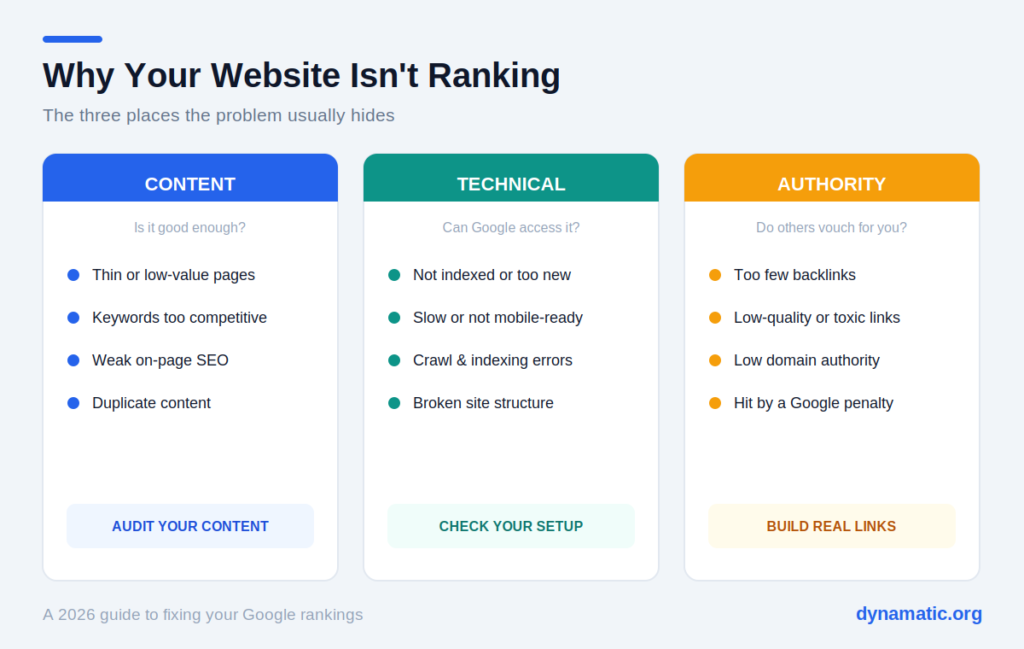
1. Your pages aren’t indexed
If Google can’t index a page, it can’t rank it. Check Google Search Console’s Pages report for indexing errors, submit your sitemap, and make sure you’re not accidentally blocking crawlers with a noindex tag or robots.txt rule.
2. Your site is too new
New sites sit in a kind of probation while Google learns to trust them. This is normal. Keep publishing quality content and earning links, and rankings typically start appearing after a few months.
3. Your content is thin or low-value
Pages that are short, generic, or don’t fully answer the searcher’s question rarely rank. Google rewards depth, originality, and genuine helpfulness. Expand thin pages, add real insight, and match what searchers actually want.
4. You’re targeting keywords that are too competitive
If you’re a new site chasing a keyword dominated by major brands, you’ll struggle no matter how good your page is. Target longer, more specific (long-tail) keywords first, build authority, then work up to competitive terms.
5. Weak on-page SEO
Missing or duplicate title tags, no clear heading structure, unoptimized meta descriptions, and poor internal linking all hold pages back. Make sure each page targets one clear keyword and signals its topic clearly.
6. Technical SEO issues
Slow load times, poor mobile usability, broken links, and messy site architecture all suppress rankings. Run your site through Google’s PageSpeed Insights and Search Console, and fix what surfaces.
7. You don’t have enough quality backlinks
This is the big one — and the reason many good sites never rank. Backlinks remain one of Google’s strongest trust signals, and if competitors have more high-quality links pointing to them, they’ll usually outrank you even with weaker content. Earning relevant, editorial links is often the single highest-impact fix. If you’d rather have it handled, professional link building services focus on exactly this, and it helps to understand how much backlinks cost before you budget.
8. Low domain authority
If your overall site authority is low, even well-optimized pages struggle. Authority is built primarily through quality backlinks and consistent, trustworthy content over time — there’s no shortcut, but it compounds.
9. Toxic backlinks or a Google penalty
Ironically, bad links can hurt as much as missing ones. If you (or a past agency) bought spammy links, you may be suppressed or penalized. Audit your backlink profile, disavow toxic links, and rebuild with white hat link building going forward.
10. You simply haven’t given it enough time
SEO is a slow compounding game. Even everything-done-right can take three to six months to show meaningful movement. Consistency beats intensity — keep going.
How to Diagnose Which Problem Is Yours
Work through it in order: confirm indexing first, then check content quality and keyword difficulty, then technical health, and finally authority and backlinks. Most sites that “won’t rank” are stuck on either content depth, backlinks, or patience — and backlinks are the one most people underestimate.
Frequently Asked Questions
How long should I wait before worrying my site isn’t ranking?
Give a new site at least three to six months of consistent effort. If quality pages still aren’t indexed or moving after that, it’s time to investigate the causes above.
Can a website rank without backlinks?
For very low-competition, long-tail terms, sometimes. For anything competitive, backlinks are almost always necessary to compete.
Why did my rankings suddenly drop?
Common causes include a Google algorithm update, new technical errors, lost backlinks, or increased competition. Check Search Console for coverage or manual-action alerts first.
Is it worth hiring help?
If you’ve fixed content and technical basics but still can’t compete, the gap is usually authority — where an experienced link building partner adds the most value.
Final Thoughts
A website that won’t rank is almost never a lost cause — it’s a diagnosis waiting to happen. Fix indexing, sharpen your content, clean up the technical side, and then invest in the authority signal most sites are missing: quality backlinks.
Stuck on the backlink side of the equation? See how Dynamatic can help you rank →
Want this applied to your campaign?
Send your domain and two competitors. We’ll run the gap analysis and show you exactly which sites would make the list — before you commit to anything.