
If you’ve researched SEO for more than five minutes, you’ve heard that backlinks matter. What’s less obvious is that how you build them matters just as much as how many you get. The methods you choose sit somewhere on a spectrum from white-hat (earned, guideline-compliant) to black-hat (manipulative and risky) and in 2026, with Google’s spam systems smarter than ever and AI search leaning heavily on trust signals, staying on the white-hat side isn’t optional. It’s the only approach that keeps your rankings safe long-term.
This guide explains what white-hat link building actually is, why it matters more than ever, the techniques that reliably work, and the tactics that can get your site penalized.
What Is White-Hat Link Building?
White-hat link building is the practice of earning backlinks through legitimate, guideline-compliant methods creating genuinely useful content, building real relationships with publishers, and securing editorial links on relevant sites that have real audiences. The defining trait is simple: you earn the link because your content deserves it, not because you manipulated or paid your way around Google’s guidelines.
It’s the opposite of chasing shortcuts. White-hat links are slower to acquire, but they compound in value, survive algorithm updates, and build the kind of authority that both Google and AI answer engines reward. If you’d rather have this handled for you, professional link building services exist precisely to do it at scale without cutting corners.
White-Hat vs Gray-Hat vs Black-Hat Link Building
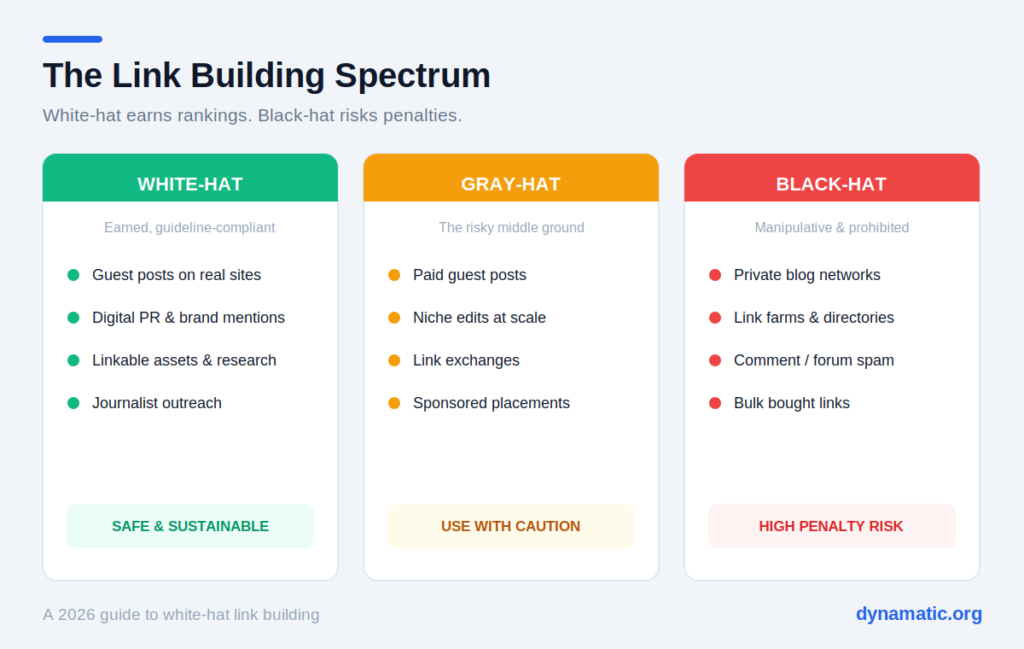
Not every tactic is clearly good or bad link building runs along a spectrum:
- White-hat: Links earned editorially through great content, digital PR, and genuine outreach. Fully aligned with Google’s guidelines.
- Gray-hat: The murky middle paid guest posts, niche edits at scale, and link exchanges. Common in the industry, technically discouraged by Google, and best used sparingly and carefully.
- Black-hat: Openly manipulative tactics like private blog networks (PBNs), link farms, and bulk-bought links. Fast in theory, but a direct route to a penalty.
Why White-Hat Link Building Matters in 2026
The case for staying white-hat has never been stronger:
- Google’s link spam systems are relentless. Modern spam-detection and core updates devalue manipulative links automatically and repeated abuse can trigger manual penalties that tank your rankings.
- AI search runs on trust. AI Overviews and answer engines cite sources they consider authoritative. Editorial, white-hat links are one of the clearest trust signals you can build.
- Sustainability. White-hat links keep working for years. Black-hat links can vanish overnight when a network is deindexed taking your rankings with them.
- Brand reputation. Links from real, respected publications put your brand in front of real audiences, not just crawlers.
Proven White-Hat Link Building Techniques
These are the methods that consistently earn quality links the right way:
1. Guest posting on relevant sites
Contributing genuinely useful articles to reputable, niche-relevant publications remains one of the most effective white-hat tactics. The key is relevance and editorial quality over volume. Many businesses use dedicated guest posting services to handle the outreach and content at scale.
2. Digital PR and data-driven content
Original surveys, studies, and newsworthy stories attract links from journalists and industry sites naturally. It’s the highest-authority form of white-hat link building.
3. Linkable assets
Free tools, calculators, original research, and definitive guides give other sites a genuine reason to link to you earning links passively over time.
4. Journalist and expert outreach
Responding to journalist requests with genuine expert commentary earns mentions and links from high-authority news sites.
5. Broken link building
Finding broken links on relevant pages and suggesting your content as a replacement is a helpful, white-hat way to earn contextual links.
6. Unlinked brand mention reclamation
When sites mention your brand without linking, a polite outreach email often turns that mention into a live backlink.
Black-Hat Tactics to Avoid
These can produce short-term movement, but the long-term risk almost always outweighs the reward:
- Private blog networks (PBNs) networks of sites built purely to pass link value.
- Buying links in bulk through link schemes that pass ranking power.
- Link farms and low-quality directories with no editorial standards.
- Comment and forum spam automated or irrelevant links dropped at scale.
- Excessive reciprocal link exchanges (“link to me and I’ll link to you”).
- Automated link-building tools that generate thousands of low-value links.
Google’s guidelines are explicit that links intended to manipulate rankings violate its policies and the systems that detect them get sharper every year.
Should You Do White-Hat Link Building In-House or Hire a Service?
White-hat link building works, but it’s time-intensive: it demands prospecting, relationship-building, content creation, and consistent follow-up. Doing it in-house gives you full control but a steep learning curve and a slow ramp.
Hiring a specialist gives you established publisher relationships and faster results. If you run an agency and want to resell links under your own brand, white label link building services handle fulfillment behind the scenes. And before you set a budget, it’s worth understanding how much backlinks cost so you can weigh the true cost of DIY versus done-for-you.
White-Hat Link Building: Frequently Asked Questions
Is white-hat link building worth it?
Yes. It’s slower than black-hat shortcuts, but the links last, compound in value, and won’t trigger penalties making it far more cost-effective over time.
How long does white-hat link building take to work?
Most sites see movement within three to six months. Because white-hat links keep their value, the impact grows the longer a quality campaign runs.
Are all paid links black-hat?
Not necessarily. Paying an agency for outreach and placement is standard practice; the line is crossed when you pay specifically to pass ranking value in violation of Google’s guidelines. Sponsored links should use the appropriate rel attributes.
Can white-hat links ever hurt my site?
Genuinely editorial, relevant links are safe. Problems arise only from manipulative patterns unnatural anchor text, irrelevant sources, or sudden bulk acquisition.
Final Thoughts
White-hat link building is the only strategy that ages well. It rewards patience, quality, and relevance exactly the traits Google and AI search reward in 2026. Skip the shortcuts, focus on earning links your content deserves, and your rankings will hold long after black-hat sites have been wiped out.
Want white-hat links built for you, the right way? Explore Dynamatic’s link building services →
Want this applied to your campaign?
Send your domain and two competitors. We’ll run the gap analysis and show you exactly which sites would make the list — before you commit to anything.